

What Is The Combined Genetic Makeup Of All Members Of A Population
Population genetics is a subfield of genetics that deals with genetic differences within and between populations, and is a part of evolutionary biology. Studies in this branch of biology examine such phenomena equally adaptation, speciation, and population structure.[1]
Population genetics was a vital ingredient in the emergence of the modern evolutionary synthesis. Its principal founders were Sewall Wright, J. B. S. Haldane and Ronald Fisher, who also laid the foundations for the related discipline of quantitative genetics. Traditionally a highly mathematical field of study, modernistic population genetics encompasses theoretical, laboratory, and field work. Population genetic models are used both for statistical inference from DNA sequence data and for proof/disproof of concept.[two]
What sets population genetics apart from newer, more phenotypic approaches to modelling evolution, such as evolutionary game theory and adaptive dynamics, is its emphasis on such genetic phenomena as say-so, epistasis, the degree to which genetic recombination breaks linkage disequilibrium, and the random phenomena of mutation and genetic migrate. This makes it advisable for comparing to population genomics data.
History [edit]
Population genetics began equally a reconciliation of Mendelian inheritance and biostatistics models. Natural selection will only cause evolution if there is enough genetic variation in a population. Before the discovery of Mendelian genetics, one common hypothesis was blending inheritance. Only with blending inheritance, genetic variance would exist rapidly lost, making evolution by natural or sexual selection implausible. The Hardy–Weinberg principle provides the solution to how variation is maintained in a population with Mendelian inheritance. According to this principle, the frequencies of alleles (variations in a gene) will remain constant in the absence of choice, mutation, migration and genetic drift.[3]
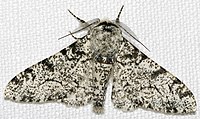
The next primal step was the piece of work of the British biologist and statistician Ronald Fisher. In a series of papers starting in 1918 and culminating in his 1930 book The Genetical Theory of Natural Selection, Fisher showed that the continuous variation measured past the biometricians could exist produced past the combined action of many discrete genes, and that natural selection could change allele frequencies in a population, resulting in evolution. In a series of papers start in 1924, another British geneticist, J. B. S. Haldane, worked out the mathematics of allele frequency change at a unmarried gene locus nether a broad range of conditions. Haldane also applied statistical analysis to existent-world examples of natural selection, such equally peppered moth evolution and industrial melanism, and showed that pick coefficients could be larger than Fisher assumed, leading to more rapid adaptive development as a camouflage strategy following increased pollution.[iv] [5]
The American biologist Sewall Wright, who had a background in animal breeding experiments, focused on combinations of interacting genes, and the effects of inbreeding on small, relatively isolated populations that exhibited genetic migrate. In 1932 Wright introduced the concept of an adaptive landscape and argued that genetic drift and inbreeding could drive a small, isolated sub-population away from an adaptive peak, allowing natural choice to drive information technology towards different adaptive peaks.[ commendation needed ]
The work of Fisher, Haldane and Wright founded the discipline of population genetics. This integrated natural selection with Mendelian genetics, which was the critical first step in developing a unified theory of how evolution worked.[4] [5] John Maynard Smith was Haldane's pupil, whilst West. D. Hamilton was influenced by the writings of Fisher. The American George R. Cost worked with both Hamilton and Maynard Smith. American Richard Lewontin and Japanese Motoo Kimura were influenced by Wright and Haldane.[ citation needed ]
Modern synthesis [edit]
The mathematics of population genetics were originally developed as the first of the modernistic synthesis. Authors such as Beatty[vi] take asserted that population genetics defines the core of the modern synthesis. For the first few decades of the 20th century, near field naturalists continued to believe that Lamarckism and orthogenesis provided the best caption for the complexity they observed in the living earth.[7] During the mod synthesis, these ideas were purged, and simply evolutionary causes that could exist expressed in the mathematical framework of population genetics were retained.[8] Consensus was reached as to which evolutionary factors might influence evolution, simply not as to the relative importance of the various factors.[8]
Theodosius Dobzhansky, a postdoctoral worker in T. H. Morgan'southward lab, had been influenced by the work on genetic diversity by Russian geneticists such every bit Sergei Chetverikov. He helped to bridge the divide between the foundations of microevolution adult by the population geneticists and the patterns of macroevolution observed by field biologists, with his 1937 book Genetics and the Origin of Species. Dobzhansky examined the genetic diversity of wild populations and showed that, reverse to the assumptions of the population geneticists, these populations had large amounts of genetic variety, with marked differences between sub-populations. The book also took the highly mathematical work of the population geneticists and put it into a more attainable form. Many more biologists were influenced by population genetics via Dobzhansky than were able to read the highly mathematical works in the original.[ix]
In Bully Britain E. B. Ford, the pioneer of ecological genetics,[10] continued throughout the 1930s and 1940s to empirically demonstrate the ability of selection due to ecological factors including the ability to maintain genetic diverseness through genetic polymorphisms such as human being blood types. Ford'due south piece of work, in collaboration with Fisher, contributed to a shift in emphasis during the mod synthesis towards natural selection as the ascendant force.[4] [v] [eleven] [12]
Neutral theory and origin-fixation dynamics [edit]
The original, modern synthesis view of population genetics assumes that mutations provide ample raw material, and focuses only on the modify in frequency of alleles within populations.[thirteen] The main processes influencing allele frequencies are natural selection, genetic drift, factor flow and recurrent mutation. Fisher and Wright had some fundamental disagreements about the relative roles of selection and drift.[14] The availability of molecular data on all genetic differences led to the neutral theory of molecular evolution. In this view, many mutations are deleterious so never observed, and most of the residuum are neutral, i.eastward. are not under pick. With the fate of each neutral mutation left to chance (genetic drift), the direction of evolutionary modify is driven by which mutations occur, and so cannot be captured past models of alter in the frequency of (existing) alleles alone.[13] [15]
The origin-fixation view of population genetics generalizes this arroyo across strictly neutral mutations, and sees the rate at which a item alter happens equally the product of the mutation rate and the fixation probability.[13]
Four processes [edit]
Selection [edit]
Natural selection, which includes sexual option, is the fact that some traits make information technology more likely for an organism to survive and reproduce. Population genetics describes natural selection by defining fitness as a propensity or probability of survival and reproduction in a particular environment. The fitness is normally given by the symbol due west=1-s where s is the selection coefficient. Natural choice acts on phenotypes, so population genetic models assume relatively elementary relationships to predict the phenotype and hence fitness from the allele at one or a small number of loci. In this way, natural option converts differences in the fitness of individuals with different phenotypes into changes in allele frequency in a population over successive generations.[ citation needed ]
Before the advent of population genetics, many biologists doubted that small differences in fitness were sufficient to make a large difference to development.[nine] Population geneticists addressed this concern in part past comparing selection to genetic drift. Option tin can overcome genetic drift when s is greater than 1 divided past the effective population size. When this criterion is met, the probability that a new advantageous mutant becomes fixed is approximately equal to 2s.[16] [17] The fourth dimension until fixation of such an allele depends niggling on genetic migrate, and is approximately proportional to log(sN)/s.[18]
Authorisation [edit]
Dominance means that the phenotypic and/or fitness effect of one allele at a locus depends on which allele is present in the 2d re-create for that locus. Consider three genotypes at one locus, with the following fettle values[xix]
| Genotype: | AaneA1 | A1A2 | A2A2 |
| Relative fitness: | 1 | one-hs | 1-southward |
| Population Genetics Glossary | |
|---|---|
| |
s is the choice coefficient and h is the dominance coefficient. The value of h yields the following information:
Epistasis [edit]

The logarithm of fitness every bit a function of the number of deleterious mutations. Synergistic epistasis is represented by the red line - each subsequent deleterious mutation has a larger proportionate effect on the organism'southward fitness. Combative epistasis is in blue. The black line shows the non-epistatic case, where fitness is the product of the contributions from each of its loci.
Epistasis ways that the phenotypic and/or fitness issue of an allele at one locus depends on which alleles are present at other loci. Option does not human activity on a unmarried locus, but on a phenotype that arises through development from a complete genotype.[20] Nonetheless, many population genetics models of sexual species are "single locus" models, where the fettle of an individual is calculated as the product of the contributions from each of its loci—effectively assuming no epistasis.
In fact, the genotype to fitness landscape is more than circuitous. Population genetics must either model this complexity in detail, or capture information technology by some simpler average rule. Empirically, beneficial mutations tend to accept a smaller fitness benefit when added to a genetic background that already has high fitness: this is known as diminishing returns epistasis.[21] When deleterious mutations also have a smaller fitness effect on high fitness backgrounds, this is known as "synergistic epistasis". However, the event of deleterious mutations tends on average to be very close to multiplicative, or tin can even show the reverse pattern, known every bit "antagonistic epistasis".[22]
Synergistic epistasis is fundamental to some theories of the purging of mutation load[23] and to the evolution of sexual reproduction.
Mutation [edit]

Mutation is the ultimate source of genetic variation in the form of new alleles. In addition, mutation may influence the direction of evolution when there is mutation bias, i.e. dissimilar probabilities for different mutations to occur. For example, recurrent mutation that tends to be in the opposite direction to selection tin lead to mutation–choice balance. At the molecular level, if mutation from G to A happens more than often than mutation from A to Thousand, then genotypes with A will tend to evolve.[24] Dissimilar insertion vs. deletion mutation biases in different taxa can lead to the evolution of different genome sizes.[25] [26] Developmental or mutational biases have also been observed in morphological evolution.[27] [28] For case, according to the phenotype-first theory of evolution, mutations can eventually crusade the genetic assimilation of traits that were previously induced by the environment.[29] [thirty]
Mutation bias effects are superimposed on other processes. If selection would favor either one out of two mutations, but there is no actress reward to having both, and then the mutation that occurs the about ofttimes is the one that is almost probable to become fixed in a population.[31] [32]
Mutation can have no effect, modify the product of a gene, or prevent the factor from functioning. Studies in the fly Drosophila melanogaster suggest that if a mutation changes a protein produced past a cistron, this volition probably be harmful, with nearly 70 percent of these mutations having damaging effects, and the remainder being either neutral or weakly beneficial.[33] Well-nigh loss of function mutations are selected confronting. Merely when selection is weak, mutation bias towards loss of function can affect evolution.[34] For example, pigments are no longer useful when animals alive in the darkness of caves, and tend to be lost.[35] This kind of loss of function can occur considering of mutation bias, and/or considering the office had a cost, and once the benefit of the function disappeared, natural selection leads to the loss. Loss of sporulation power in a bacterium during laboratory development appears to have been caused past mutation bias, rather than natural pick confronting the cost of maintaining sporulation ability.[36] When there is no option for loss of function, the speed at which loss evolves depends more on the mutation rate than information technology does on the constructive population size,[37] indicating that it is driven more past mutation bias than past genetic drift.
Mutations can involve large sections of DNA becoming duplicated, usually through genetic recombination.[38] This leads to re-create-number variation within a population. Duplications are a major source of raw material for evolving new genes.[39] Other types of mutation occasionally create new genes from previously noncoding Dna.[40] [41]
Genetic drift [edit]
Genetic drift is a change in allele frequencies acquired by random sampling.[42] That is, the alleles in the offspring are a random sample of those in the parents.[43] Genetic drift may crusade factor variants to disappear completely, and thereby reduce genetic variability. In contrast to natural selection, which makes factor variants more common or less mutual depending on their reproductive success,[44] the changes due to genetic drift are not driven by ecology or adaptive pressures, and are every bit likely to make an allele more mutual as less common.
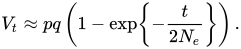
The effect of genetic drift is larger for alleles present in few copies than when an allele is nowadays in many copies. The population genetics of genetic drift are described using either branching processes or a diffusion equation describing changes in allele frequency.[45] These approaches are usually applied to the Wright-Fisher and Moran models of population genetics. Assuming genetic drift is the only evolutionary forcefulness acting on an allele, after t generations in many replicated populations, starting with allele frequencies of p and q, the variance in allele frequency across those populations is
- [46]
Ronald Fisher held the view that genetic drift plays at the well-nigh a minor role in evolution, and this remained the dominant view for several decades. No population genetics perspective take e'er given genetic drift a central role past itself, merely some have made genetic migrate important in combination with another non-selective strength. The shifting balance theory of Sewall Wright held that the combination of population structure and genetic drift was important. Motoo Kimura's neutral theory of molecular evolution claims that near genetic differences within and between populations are caused by the combination of neutral mutations and genetic drift.[47]
The office of genetic migrate by ways of sampling error in development has been criticized past John H Gillespie[48] and Volition Provine,[49] who fence that option on linked sites is a more important stochastic strength, doing the work traditionally ascribed to genetic drift past means of sampling mistake. The mathematical properties of genetic draft are different from those of genetic drift.[fifty] The direction of the random change in allele frequency is autocorrelated across generations.[42]
Gene catamenia [edit]
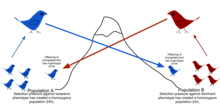
Gene flow is the transfer of alleles from ane population to some other population through immigration of individuals. In this example, 1 of the birds from population A immigrates to population B, which has fewer of the dominant alleles, and through mating incorporates its alleles into the other population.
Because of physical barriers to migration, along with the limited tendency for individuals to move or spread (vagility), and trend to remain or come dorsum to natal identify (philopatry), natural populations rarely all interbreed as may exist assumed in theoretical random models (panmixy).[51] There is usually a geographic range inside which individuals are more closely related to one another than those randomly selected from the general population. This is described every bit the extent to which a population is genetically structured.[52]
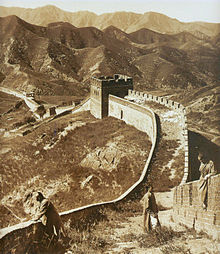
Genetic structuring tin exist caused by migration due to historical climate change, species range expansion or current availability of habitat. Gene flow is hindered by mountain ranges, oceans and deserts or even man-made structures such every bit the Great Wall of China, which has hindered the catamenia of plant genes.[53]
Factor flow is the exchange of genes betwixt populations or species, breaking downward the structure. Examples of gene menstruation within a species include the migration and and then convenance of organisms, or the exchange of pollen. Gene transfer between species includes the formation of hybrid organisms and horizontal gene transfer. Population genetic models can exist used to identify which populations evidence pregnant genetic isolation from one another, and to reconstruct their history.[54]
Subjecting a population to isolation leads to inbreeding depression. Migration into a population can introduce new genetic variants,[55] potentially contributing to evolutionary rescue. If a pregnant proportion of individuals or gametes migrate, information technology can as well modify allele frequencies, e.g. giving rising to migration load.[56]
In the presence of gene flow, other barriers to hybridization between ii diverging populations of an outcrossing species are required for the populations to become new species.
Horizontal cistron transfer [edit]
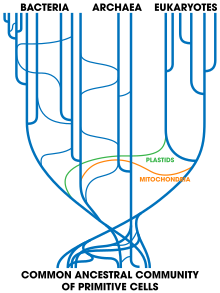
Current tree of life showing vertical and horizontal gene transfers.
Horizontal gene transfer is the transfer of genetic material from ane organism to another organism that is not its offspring; this is most mutual among prokaryotes.[57] In medicine, this contributes to the spread of antibody resistance, equally when one bacteria acquires resistance genes it tin rapidly transfer them to other species.[58] Horizontal transfer of genes from leaner to eukaryotes such as the yeast Saccharomyces cerevisiae and the adzuki edible bean beetle Callosobruchus chinensis may also take occurred.[59] [60] An example of larger-scale transfers are the eukaryotic bdelloid rotifers, which appear to have received a range of genes from bacteria, fungi, and plants.[61] Viruses can likewise comport DNA betwixt organisms, allowing transfer of genes even across biological domains.[62] Large-scale gene transfer has besides occurred betwixt the ancestors of eukaryotic cells and prokaryotes, during the acquisition of chloroplasts and mitochondria.[63]
Linkage [edit]
If all genes are in linkage equilibrium, the event of an allele at one locus can exist averaged across the genetic pool at other loci. In reality, 1 allele is frequently found in linkage disequilibrium with genes at other loci, specially with genes located nearby on the same chromosome. Recombination breaks upward this linkage disequilibrium too slowly to avert genetic hitchhiking, where an allele at one locus rises to high frequency because it is linked to an allele under selection at a nearby locus. Linkage as well slows downwards the charge per unit of adaptation, even in sexual populations.[64] [65] [66] The effect of linkage disequilibrium in slowing down the rate of adaptive evolution arises from a combination of the Hill–Robertson event (delays in bringing beneficial mutations together) and groundwork selection (delays in separating beneficial mutations from deleterious hitchhikers).
Linkage is a problem for population genetic models that treat ane gene locus at a time. It can, however, be exploited equally a method for detecting the action of natural selection via selective sweeps.
In the farthermost case of an asexual population, linkage is complete, and population genetic equations can exist derived and solved in terms of a travelling wave of genotype frequencies along a elementary fettle landscape.[67] Most microbes, such as bacteria, are asexual. The population genetics of their accommodation have ii contrasting regimes. When the product of the benign mutation rate and population size is small, asexual populations follow a "successional regime" of origin-fixation dynamics, with adaptation rate strongly dependent on this product. When the product is much larger, asexual populations follow a "concurrent mutations" authorities with adaptation rate less dependent on the product, characterized by clonal interference and the advent of a new beneficial mutation before the last one has stock-still.
Applications [edit]
Explaining levels of genetic variation [edit]
Neutral theory predicts that the level of nucleotide diversity in a population will be proportional to the product of the population size and the neutral mutation rate. The fact that levels of genetic multifariousness vary much less than population sizes practice is known equally the "paradox of variation".[68] While loftier levels of genetic variety were one of the original arguments in favor of neutral theory, the paradox of variation has been i of the strongest arguments against neutral theory.
Information technology is clear that levels of genetic variety vary profoundly within a species as a function of local recombination rate, due to both genetic hitchhiking and groundwork pick. Almost current solutions to the paradox of variation invoke some level of selection at linked sites.[69] For example, one analysis suggests that larger populations have more selective sweeps, which remove more neutral genetic variety.[70] A negative correlation between mutation charge per unit and population size may likewise contribute.[71]
Life history affects genetic variety more than population history does, east.g. r-strategists take more than genetic diversity.[69]
Detecting pick [edit]
Population genetics models are used to infer which genes are undergoing selection. One common approach is to look for regions of high linkage disequilibrium and low genetic variance along the chromosome, to detect contempo selective sweeps.
A 2d mutual arroyo is the McDonald–Kreitman exam which compares the corporeality of variation within a species (polymorphism) to the difference between species (substitutions) at two types of sites; one assumed to exist neutral. Typically, synonymous sites are causeless to be neutral.[72] Genes undergoing positive option have an excess of divergent sites relative to polymorphic sites. The examination can as well be used to obtain a genome-broad estimate of the proportion of substitutions that are fixed by positive selection, α.[73] [74] According to the neutral theory of molecular evolution, this number should be near zero. High numbers have therefore been interpreted as a genome-wide falsification of neutral theory.[75]
Demographic inference [edit]
The simplest examination for population structure in a sexually reproducing, diploid species, is to come across whether genotype frequencies follow Hardy-Weinberg proportions as a function of allele frequencies. For instance, in the simplest case of a single locus with 2 alleles denoted A and a at frequencies p and q, random mating predicts freq(AA) =p 2 for the AA homozygotes, freq(aa) =q two for the aa homozygotes, and freq(Aa) = iipq for the heterozygotes. In the absence of population structure, Hardy-Weinberg proportions are reached within i-ii generations of random mating. More than typically, there is an excess of homozygotes, indicative of population structure. The extent of this excess tin be quantified as the inbreeding coefficient, F.
Individuals can be clustered into K subpopulations.[76] [77] The degree of population structure tin can then be calculated using FST, which is a mensurate of the proportion of genetic variance that can be explained by population structure. Genetic population structure tin can and so exist related to geographic structure, and genetic admixture can be detected.
Coalescent theory relates genetic diversity in a sample to demographic history of the population from which it was taken. Information technology normally assumes neutrality, and and then sequences from more than neutrally-evolving portions of genomes are therefore selected for such analyses. Information technology tin be used to infer the relationships between species (phylogenetics), besides equally the population structure, demographic history (e.g. population bottlenecks, population growth), biological dispersal, source–sink dynamics[78] and introgression within a species.
Another approach to demographic inference relies on the allele frequency spectrum.[79]
Evolution of genetic systems [edit]
Past bold that there are loci that control the genetic system itself, population genetic models are created to describe the evolution of dominance and other forms of robustness, the evolution of sexual reproduction and recombination rates, the evolution of mutation rates, the evolution of evolutionary capacitors, the evolution of costly signalling traits, the evolution of ageing, and the development of co-operation. For case, well-nigh mutations are deleterious, and so the optimal mutation rate for a species may be a merchandise-off between the damage from a loftier deleterious mutation charge per unit and the metabolic costs of maintaining systems to reduce the mutation rate, such equally DNA repair enzymes.[80]
One of import aspect of such models is that selection is only strong enough to purge deleterious mutations and hence overpower mutational bias towards deposition if the selection coefficient s is greater than the changed of the effective population size. This is known as the drift barrier and is related to the nearly neutral theory of molecular development. Drift barrier theory predicts that species with large effective population sizes will take highly streamlined, efficient genetic systems, while those with small population sizes will take bloated and complex genomes containing for example introns and transposable elements.[81] However, somewhat paradoxically, species with large population sizes might exist so tolerant to the consequences of certain types of errors that they evolve higher error rates, e.one thousand. in transcription and translation, than small-scale populations.[82]
Run across as well [edit]
- Genotype–phenotype distinction
- Haldane's dilemma
- Human genetic variation
- Laboratory experiments of speciation
- Listing of population genetics projects
- Muller's ratchet
- Viral quasispecies
References [edit]
- ^ "Population genetics - Latest research and news". www.nature.com . Retrieved 2018-01-29 .
- ^ Servedio, Maria R.; Brandvain, Yaniv; Dhole, Sumit; Fitzpatrick, Courtney L.; Goldberg, Emma E.; Stern, Caitlin A.; Van Cleve, Jeremy; Yeh, D. Justin (nine December 2014). "Not Just a Theory—The Utility of Mathematical Models in Evolutionary Biology". PLOS Biological science. 12 (12): e1002017. doi:10.1371/journal.pbio.1002017. PMC4260780. PMID 25489940.
- ^ Ewens, W.J. (2004). Mathematical Population Genetics (second ed.). New York: Springer. ISBN978-0-387-20191-vii.
- ^ a b c Bowler, Peter J. (2003). Development : the history of an idea (3rd ed.). Berkeley: University of California Press. pp. 325–339. ISBN978-0-520-23693-6.
- ^ a b c Larson, Edward J. (2004). Evolution : the remarkable history of a scientific theory (Modern Library ed.). New York: Modern Library. pp. 221–243. ISBN978-0-679-64288-six.
- ^ Beatty, John (1986). "The Synthesis and the Synthetic Theory". Integrating Scientific Disciplines. Scientific discipline and Philosophy. Vol. two. Springer Netherlands. pp. 125–135. doi:x.1007/978-94-010-9435-1_7. ISBN9789024733422.
- ^ Mayr, Ernst; Provine, William B., eds. (1998). The Evolutionary synthesis : perspectives on the unification of biology ([New ed]. ed.). Cambridge, Massachusetts: Harvard Academy Printing. pp. 295–298. ISBN9780674272262.
- ^ a b Provine, W. B. (1988). "Progress in development and meaning in life". Evolutionary progress. University of Chicago Press. pp. 49–79.
- ^ a b Provine, William B. (1978). "The role of mathematical population geneticists in the evolutionary synthesis of the 1930s and 1940s". Studies of the History of Biological science. 2: 167–192. PMID 11610409.
- ^ Ford, Eastward. B. (1975) [1964]. Ecological genetics (4th ed.). London: Chapman and Hall. pp. 1ff.
- ^ Mayr, Ernst (1988). Toward a New Philosophy of Biology: Observations of an Evolutionist. Cambridge, Massachusetts: Belknap Press of Harvard University Press. p. 402. ISBN978-0-674-89665-ix.
- ^ Mayr, Ernst; Provine, William B., eds. (1998). The Evolutionary Synthesis : perspectives on the unification of biology ([New ed]. ed.). Cambridge, Massachusetts: Harvard University Press. pp. 338–341. ISBN9780674272262.
- ^ a b c McCandlish, David M.; Stoltzfus, Arlin (September 2014). "Modeling Evolution Using the Probability of Fixation: History and Implications". The Quarterly Review of Biological science. 89 (3): 225–252. doi:10.1086/677571. PMID 25195318. S2CID 19619966.
- ^ Crow, James F. (2010). "Wright and Fisher on Inbreeding and Random Drift". Genetics. 184 (three): 609–611. doi:10.1534/genetics.109.110023. ISSN 0016-6731. PMC2845331. PMID 20332416.
- ^ Casillas, Sònia; Barbadilla, Antonio (2017). "Molecular Population Genetics". Genetics. 205 (three): 1003–1035. doi:x.1534/genetics.116.196493. PMC5340319. PMID 28270526.
- ^ Haldane, J. B. S. (1927). "A Mathematical Theory of Natural and Bogus Selection, Office 5: Selection and Mutation". Mathematical Proceedings of the Cambridge Philosophical Lodge. 23 (7): 838–844. Bibcode:1927PCPS...23..838H. doi:x.1017/S0305004100015644.
- ^ Orr, H. A. (2010). "The population genetics of benign mutations". Philosophical Transactions of the Majestic Society B: Biological Sciences. 365 (1544): 1195–1201. doi:10.1098/rstb.2009.0282. PMC2871816. PMID 20308094.
- ^ Hermisson, J.; Pennings, P. S. (2005). "Soft sweeps: molecular population genetics of adaptation from standing genetic variation". Genetics. 169 (4): 2335–2352. doi:10.1534/genetics.104.036947. PMC1449620. PMID 15716498.
- ^ Gillespie, John (2004). Population Genetics: A Concise Guide (2nd ed.). Johns Hopkins Academy Press. ISBN978-0-8018-8008-7.
- ^ Miko, I. (2008). "Epistasis: Gene interaction and phenotype effects". Nature Education. 1 (ane): 197.
- ^ Berger, D.; Postma, E. (13 October 2014). "Biased Estimates of Diminishing-Returns Epistasis? Empirical Testify Revisited". Genetics. 198 (four): 1417–1420. doi:10.1534/genetics.114.169870. PMC4256761. PMID 25313131.
- ^ Kouyos, Roger D.; Silander, Olin G.; Bonhoeffer, Sebastian (June 2007). "Epistasis between deleterious mutations and the development of recombination". Trends in Environmental & Evolution. 22 (six): 308–315. doi:10.1016/j.tree.2007.02.014. PMID 17337087.
- ^ Crow, J. F. (5 August 1997). "The high spontaneous mutation rate: is information technology a health run a risk?". Proceedings of the National Academy of Sciences of the The states of America. 94 (16): 8380–8386. Bibcode:1997PNAS...94.8380C. doi:x.1073/pnas.94.16.8380. PMC33757. PMID 9237985.
- ^ Smith, N. G. C.; Webster, Grand. T.; Ellegren, H. (2002). "Deterministic Mutation Rate Variation in the Homo Genome". Genome Enquiry. 12 (nine): 1350–1356. doi:10.1101/gr.220502. PMC186654. PMID 12213772.
- ^ Petrov, D. A. (2000). "Prove for Deoxyribonucleic acid Loss every bit a Determinant of Genome Size". Scientific discipline. 287 (5455): 1060–1062. Bibcode:2000Sci...287.1060P. doi:x.1126/science.287.5455.1060. ISSN 0036-8075. PMID 10669421.
- ^ Petrov, D. A. (2002). "DNA loss and development of genome size in Drosophila". Genetica. 115 (1): 81–91. doi:ten.1023/A:1016076215168. PMID 12188050. S2CID 5314242.
- ^ Kiontke, K.; Barrière, A.; Kolotuev, I.; Podbilewicz, B.; Sommer, R.; Fitch, D. H. A.; Félix, K. A. (2007). "Trends, stasis, and migrate in the development of nematode vulva development". Current Biology. 17 (22): 1925–1937. doi:10.1016/j.cub.2007.10.061. PMID 18024125. S2CID 4503181.
- ^ Braendle, C.; Baer, C. F.; Félix, M. A. (2010). Barsh, Gregory S. (ed.). "Bias and Evolution of the Mutationally Accessible Phenotypic Space in a Developmental System". PLOS Genetics. 6 (3): e1000877. doi:10.1371/journal.pgen.1000877. PMC2837400. PMID 20300655.
- ^ Palmer, RA (2004). "Symmetry breaking and the evolution of development". Scientific discipline. 306 (5697): 828–833. Bibcode:2004Sci...306..828P. CiteSeerX10.1.i.631.4256. doi:10.1126/science.1103707. PMID 15514148. S2CID 32054147.
- ^ West-Eberhard, M-J. (2003). Developmental plasticity and evolution. New York: Oxford University Press. ISBN978-0-xix-512235-0.
- ^ Stoltzfus, A.; Yampolsky, Fifty. Y. (2009). "Climbing Mountain Probable: Mutation equally a Cause of Nonrandomness in Evolution". Journal of Heredity. 100 (5): 637–647. doi:ten.1093/jhered/esp048. PMID 19625453.
- ^ Yampolsky, L. Y.; Stoltzfus, A. (2001). "Bias in the introduction of variation as an orienting cistron in evolution". Evol Dev. 3 (2): 73–83. doi:10.1046/j.1525-142x.2001.003002073.x. PMID 11341676. S2CID 26956345.
- ^ Sawyer, S. A.; Parsch, J.; Zhang, Z.; Hartl, D. L. (2007). "Prevalence of positive selection among nearly neutral amino acid replacements in Drosophila". Proceedings of the National Academy of Sciences. 104 (xvi): 6504–6510. doi:10.1073/pnas.0701572104. ISSN 0027-8424. PMC1871816. PMID 17409186.
- ^ Haldane, J. B. S. (1933). "The Part Played by Recurrent Mutation in Evolution". American Naturalist. 67 (708): 5–xix. doi:ten.1086/280465. JSTOR 2457127. S2CID 84059440.
- ^ Protas, Meredith; Conrad, Thou.; Gross, J. B.; Tabin, C.; Borowsky, R (2007). "Regressive evolution in the Mexican cave tetra, Astyanax mexicanus". Electric current Biology. 17 (5): 452–454. doi:x.1016/j.cub.2007.01.051. PMC2570642. PMID 17306543.
- ^ Maughan, H.; Masel, J.; Birky, W. C.; Nicholson, W. L. (2007). "The roles of mutation accumulation and option in loss of sporulation in experimental populations of Bacillus subtilis". Genetics. 177 (2): 937–948. doi:10.1534/genetics.107.075663. PMC2034656. PMID 17720926.
- ^ Masel, J.; Rex, O. D.; Maughan, H. (2007). "The loss of adaptive plasticity during long periods of environmental stasis". American Naturalist. 169 (one): 38–46. doi:10.1086/510212. PMC1766558. PMID 17206583.
- ^ Hastings, P. J.; Lupski, J. R.; Rosenberg, Due south. M.; Ira, G. (2009). "Mechanisms of modify in gene copy number". Nature Reviews Genetics. ten (viii): 551–564. doi:10.1038/nrg2593. PMC2864001. PMID 19597530.
- ^ One thousand., Long; Betrán, East.; Thornton, Chiliad.; Wang, Westward. (November 2003). "The origin of new genes: glimpses from the young and old". Nat. Rev. Genet. 4 (11): 865–75. doi:10.1038/nrg1204. PMID 14634634. S2CID 33999892.
- ^ Liu, North.; Okamura, G.; Tyler, D. Grand.; Phillips; Chung; Lai (2008). "The development and functional diversification of animal microRNA genes". Cell Inquiry. eighteen (x): 985–996. doi:10.1038/cr.2008.278. PMC2712117. PMID 18711447.
- ^ McLysaght, Aoife; Hurst, Laurence D. (25 July 2016). "Open up questions in the study of de novo genes: what, how and why". Nature Reviews Genetics. 17 (9): 567–578. doi:x.1038/nrg.2016.78. PMID 27452112. S2CID 6033249.
- ^ a b Masel, J. (2011). "Genetic drift". Electric current Biology. 21 (20): R837–R838. doi:10.1016/j.cub.2011.08.007. PMID 22032182.
- ^ Futuyma, Douglas (1998). Evolutionary Biology. Sinauer Associates. p. Glossary. ISBN978-0-87893-189-7.
- ^ Avers, Charlotte (1989). Procedure and Design in Evolution. Oxford University Press.
- ^ Wahl, L. M. (2011). "Fixation when N and southward Vary: Classic Approaches Give Elegant New Results". Genetics. 188 (4): 783–785. doi:10.1534/genetics.111.131748. PMC3176088. PMID 21828279.
- ^ Barton, Nicholas H.; Briggs, Derek E. K.; Eisen, Jonathan A.; Goldstein, David B.; Patel, Nipam H. (2007). Evolution. Cold Spring Harbor Laboratory Press. p. 417. ISBN978-0-87969-684-ix.
- ^ Futuyma, Douglas (1998). Evolutionary Biology. Sinauer Associates. p. 320. ISBN978-0-87893-189-vii.
- ^ Gillespie, J. H. (2000). "Genetic Drift in an Space Population: The Pseudohitchhiking Model". Genetics. 155 (2): 909–919. doi:10.1093/genetics/155.2.909. PMC1461093. PMID 10835409.
- ^ Provine, William B. The "Random Genetic Drift" Fallacy. CreateSpace.
- ^ Neher, Richard A.; Shraiman, Boris I. (August 2011). "Genetic Typhoon and Quasi-Neutrality in Large Facultatively Sexual Populations". Genetics. 188 (iv): 975–996. arXiv:1108.1635. doi:10.1534/genetics.111.128876. ISSN 0016-6731. PMC3176096. PMID 21625002.
- ^ Buston, P. K.; Pilkington, J. G.; et al. (2007). "Are clownfish groups composed of close relatives? An analysis of microsatellite Dna vraiation in Amphiprion percula". Molecular Ecology. 12 (3): 733–742. doi:10.1046/j.1365-294X.2003.01762.x. PMID 12675828. S2CID 35546810.
- ^ Repaci, V.; Stow, A. J.; Briscoe, D. A. (2007). "Fine-scale genetic construction, co-founding and multiple mating in the Australian allodapine bee (Ramphocinclus brachyurus)". Periodical of Zoology. 270 (4): 687–691. doi:ten.1111/j.1469-7998.2006.00191.x.
- ^ a b Su, H.; Qu, L.-J.; He, K.; Zhang, Z.; Wang, J; Chen, Z.; Gu, H. (2003). "The Great Wall of China: a concrete bulwark to cistron catamenia?". Heredity. 90 (3): 212–219. doi:ten.1038/sj.hdy.6800237. ISSN 0018-067X. PMID 12634804. S2CID 13367320.
- ^ Gravel, S. (2012). "Population Genetics Models of Local Ancestry". Genetics. 1202 (two): 607–619. arXiv:1202.4811. Bibcode:2012arXiv1202.4811G. doi:10.1534/genetics.112.139808. PMC3374321. PMID 22491189.
- ^ Morjan, C.; Rieseberg, Fifty. (2004). "How species evolve collectively: implications of gene menses and selection for the spread of advantageous alleles". Molecular Ecology. 13 (6): 1341–56. doi:x.1111/j.1365-294X.2004.02164.x. PMC2600545. PMID 15140081.
- ^ Bolnick, Daniel I.; Nosil, Patrik (September 2007). "Natural Selection in Populations Discipline to a Migration Load". Evolution. 61 (9): 2229–2243. doi:10.1111/j.1558-5646.2007.00179.x. PMID 17767592. S2CID 25685919.
- ^ Boucher, Yan; Douady, Christophe J.; Papke, R. Thane; Walsh, David A.; Boudreau, Mary Ellen R.; Nesbø, Camilla L.; Case, Rebecca J.; Doolittle, W. Ford (2003). "Lateral Gene Transfer and the Origins of Prokaryotic Groups". Annual Review of Genetics. 37 (1): 283–328. doi:10.1146/annurev.genet.37.050503.084247. ISSN 0066-4197. PMID 14616063.
- ^ Walsh, T. (2006). "Combinatorial genetic development of multiresistance". Electric current Opinion in Microbiology. 9 (5): 476–82. doi:10.1016/j.mib.2006.08.009. PMID 16942901.
- ^ Kondo, N.; Nikoh, N.; Ijichi, N.; Shimada, Thousand.; Fukatsu, T. (2002). "Genome fragment of Wolbachia endosymbiont transferred to X chromosome of host insect". Proceedings of the National University of Sciences. 99 (22): 14280–14285. Bibcode:2002PNAS...9914280K. doi:10.1073/pnas.222228199. ISSN 0027-8424. PMC137875. PMID 12386340.
- ^ Sprague, One thousand. (1991). "Genetic substitution between kingdoms". Current Opinion in Genetics & Development. ane (iv): 530–533. doi:ten.1016/S0959-437X(05)80203-5. PMID 1822285.
- ^ Gladyshev, E. A.; Meselson, M.; Arkhipova, I. R. (2008). "Massive Horizontal Factor Transfer in Bdelloid Rotifers". Science. 320 (5880): 1210–1213. Bibcode:2008Sci...320.1210G. doi:10.1126/science.1156407. ISSN 0036-8075. PMID 18511688. S2CID 11862013.
- ^ Baldo, A.; McClure, M. (1 September 1999). "Evolution and horizontal transfer of dUTPase-encoding genes in viruses and their hosts". Periodical of Virology. 73 (9): 7710–7721. doi:ten.1128/JVI.73.ix.7710-7721.1999. PMC104298. PMID 10438861.
- ^ Poole, A.; Penny, D. (2007). "Evaluating hypotheses for the origin of eukaryotes". BioEssays. 29 (one): 74–84. doi:10.1002/bies.20516. PMID 17187354.
- ^ Weissman, D. B.; Hallatschek, O. (fifteen January 2014). "The Rate of Adaptation in Big Sexual Populations with Linear Chromosomes". Genetics. 196 (4): 1167–1183. doi:10.1534/genetics.113.160705. PMC3982688. PMID 24429280.
- ^ Weissman, Daniel B.; Barton, Nicholas H.; McVean, Gil (7 June 2012). "Limits to the Rate of Adaptive Commutation in Sexual Populations". PLOS Genetics. 8 (six): e1002740. doi:10.1371/journal.pgen.1002740. PMC3369949. PMID 22685419.
- ^ Neher, R. A.; Shraiman, B. I.; Fisher, D. Due south. (30 November 2009). "Rate of Adaptation in Large Sexual Populations". Genetics. 184 (2): 467–481. arXiv:1108.3464. doi:10.1534/genetics.109.109009. PMC2828726. PMID 19948891.
- ^ Desai, Michael M.; Fisher, Daniel S. (2007). "Benign Mutation Selection Balance and the Issue of Linkage on Positive Choice". Genetics. 176 (iii): 1759–1798. doi:10.1534/genetics.106.067678. PMC1931526. PMID 17483432.
- ^ Lewontin, R. C. (1973). The genetic basis of evolutionary change ([4th printing.] ed.). New York: Columbia University Press. ISBN978-0231033923.
- ^ a b Ellegren, Hans; Galtier, Nicolas (6 June 2016). "Determinants of genetic multifariousness". Nature Reviews Genetics. 17 (7): 422–433. doi:10.1038/nrg.2016.58. PMID 27265362. S2CID 23531428.
- ^ Corbett-Detig, Russell B.; Hartl, Daniel L.; Sackton, Timothy B.; Barton, Nick H. (10 April 2015). "Natural Option Constrains Neutral Multifariousness beyond A Broad Range of Species". PLOS Biology. 13 (4): e1002112. doi:x.1371/journal.pbio.1002112. PMC4393120. PMID 25859758.
- ^ Sung, W.; Ackerman, M. S.; Miller, S. F.; Doak, T. G.; Lynch, 1000. (17 October 2012). "Drift-barrier hypothesis and mutation-rate evolution" (PDF). Proceedings of the National Academy of Sciences. 109 (45): 18488–18492. Bibcode:2012PNAS..10918488S. doi:10.1073/pnas.1216223109. PMC3494944. PMID 23077252.
- ^ Charlesworth, J. Eyre-Walker (2008). "The McDonald–Kreitman Test and Slightly Deleterious Mutations". Molecular Biological science and Evolution. 25 (6): 1007–1015. doi:ten.1093/molbev/msn005. PMID 18195052.
- ^ Eyre-Walker, A. (2006). "The genomic rate of adaptive development" (PDF). Trends in Ecology and Development. 21 (10): 569–575. doi:10.1016/j.tree.2006.06.015. PMID 16820244.
- ^ Smith, North. Thou. C.; Eyre-Walker, A. (2002). "Adaptive protein evolution in Drosophila". Nature. 415 (6875): 1022–1024. Bibcode:2002Natur.415.1022S. doi:10.1038/4151022a. PMID 11875568. S2CID 4426258.
- ^ Hahn, Thou. W. (2008). "Toward a pick theory of molecular development". Evolution. 62 (two): 255–265. doi:x.1111/j.1558-5646.2007.00308.x. PMID 18302709. S2CID 5986211.
- ^ Pritchard, J. K.; Stephens, M.; Donnelly, P. (June 2000). "Inference of population construction using multilocus genotype data". Genetics. 155 (2): 945–959. doi:10.1093/genetics/155.2.945. ISSN 0016-6731. PMC1461096. PMID 10835412.
- ^ Verity, Robert; Nichols, Richard A. (August 2016). "Estimating the Number of Subpopulations (Grand) in Structured Populations". Genetics. 203 (4): 1827–1839. doi:10.1534/genetics.115.180992. ISSN 0016-6731. PMC4981280. PMID 27317680.
- ^ Manlik, Oliver; Chabanne, Delphine; Daniel, Claire; Bejder, Lars; Allen, Simon J.; Sherwin, William B. (13 November 2018). "Demography and genetics suggest reversal of dolphin source–sink dynamics, with implications for conservation". Marine Mammal Science. 35 (3): 732–759. doi:10.1111/mms.12555.
- ^ Gutenkunst, Ryan N.; Hernandez, Ryan D.; Williamson, Scott H.; Bustamante, Carlos D.; McVean, Gil (23 Oct 2009). "Inferring the Joint Demographic History of Multiple Populations from Multidimensional SNP Frequency Data". PLOS Genetics. 5 (ten): e1000695. arXiv:0909.0925. doi:ten.1371/journal.pgen.1000695. PMC2760211. PMID 19851460.
- ^ Sniegowski, P. (2000). Gerrish P.; Johnson T;. Shaver A. "The evolution of mutation rates: separating causes from consequences". BioEssays. 22 (12): 1057–1066. doi:ten.1002/1521-1878(200012)22:12<1057::Aid-BIES3>3.0.CO;ii-W. PMID 11084621.
- ^ Lynch, Michael; Conery, John S. (2003). "The origins of genome complexity". Science. 302 (5649): 1401–1404. Bibcode:2003Sci...302.1401L. CiteSeerX10.ane.1.135.974. doi:x.1126/science.1089370. PMID 14631042. S2CID 11246091.
- ^ Rajon, E.; Masel, J. (3 January 2011). "Development of molecular error rates and the consequences for evolvability". Proceedings of the National University of Sciences. 108 (three): 1082–1087. Bibcode:2011PNAS..108.1082R. doi:10.1073/pnas.1012918108. PMC3024668. PMID 21199946.
External links [edit]
- Population Genetics Tutorials
- Molecular population genetics
- The ALlele FREquency Database at Yale Academy
- EHSTRAFD.org - World Human STR Allele Frequencies Database
- History of population genetics
- How Selection Changes the Genetic Composition of Population, video of lecture by Stephen C. Stearns (Yale University)
- National Geographic: Atlas of the Human Journey (Haplogroup-based human migration maps)

What Is The Combined Genetic Makeup Of All Members Of A Population,
Source: https://en.wikipedia.org/wiki/Population_genetics
Posted by: wardbuited.blogspot.com
0 Response to "What Is The Combined Genetic Makeup Of All Members Of A Population"
Post a Comment